
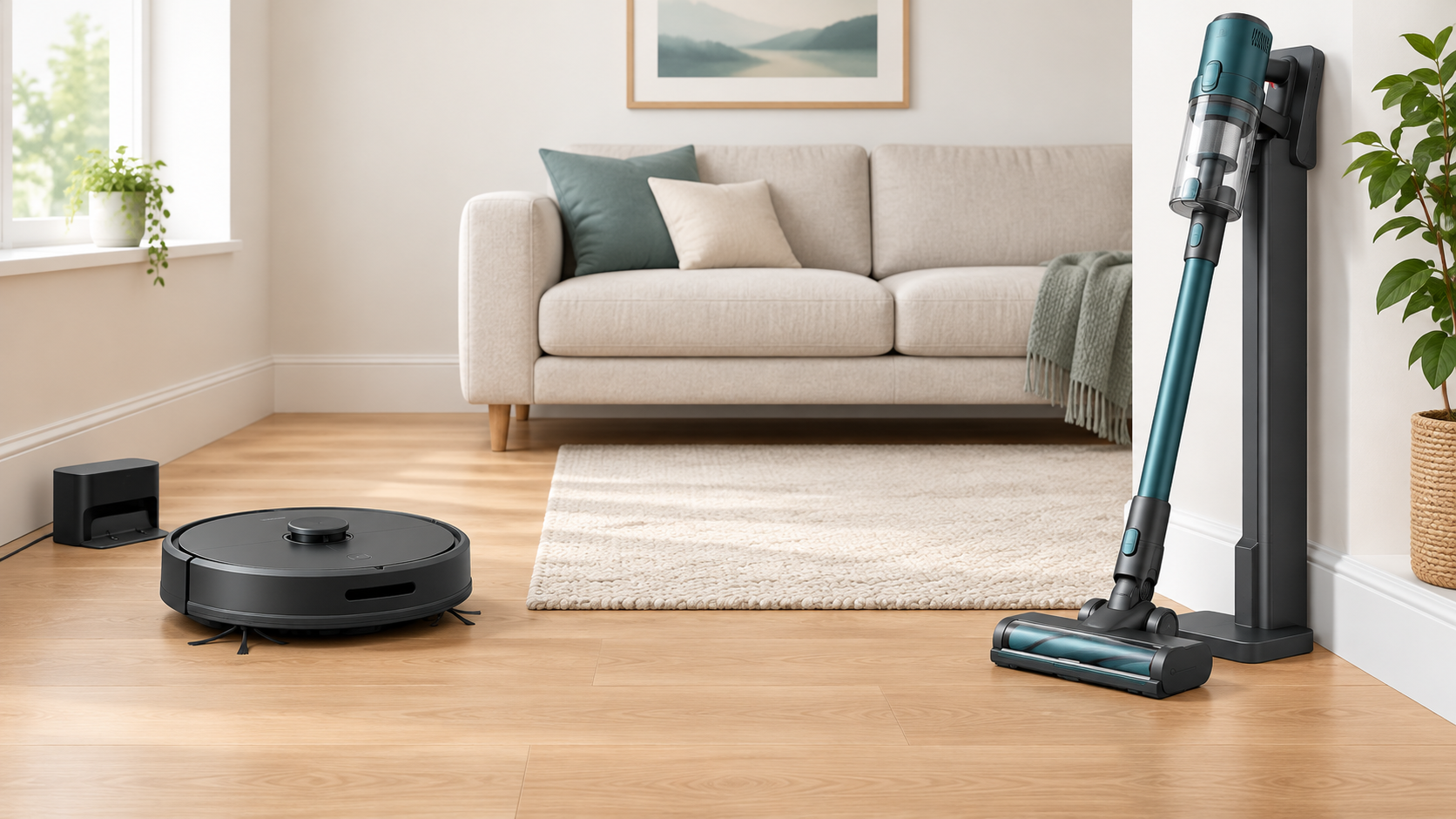
If you need one machine for floors, stairs and upholstery, a cordless stick with suitable handheld tools may be the more versatile choice. Check its tested floor performance, weight and included accessories.
A robot is worth considering when you want to automate routine floor cleaning, especially if you already have a suitable way to tackle the jobs it cannot cover. If your existing vacuum does everything you need and you are content using it, another appliance may be unnecessary.
Disclosure: Bot ’n’ Brush has not personally tested these products. This comparison draws on independent testing and official UK documentation. It is an assessment of cleaning jobs and ownership demands, not a head-to-head laboratory result.
The important distinction is between versatility, cleaning performance and convenience. A machine can cover more tasks without cleaning every floor better. Equally, one that automates your floors may still be unsuitable as your household’s only vacuum.
What each can actually clean
Here, “cordless vacuum” means a cordless stick, with handheld use only where the particular model supports it. “Robot vacuum” means a conventional autonomous floor-cleaning robot; charging and emptying docks are separate features.
| Task | Robot vacuum | Cordless stick | What to check |
|---|---|---|---|
| Routine accessible floors | Automates floor cleaning within the areas it can reach. | Requires you to guide it around the floor. | Floor layout, obstacles and independent pickup results. |
| Carpet | Performance varies with the model and carpet. | Performance also varies; cordless does not guarantee strong carpet pickup. | Tests covering relevant carpet types. |
| Individual stair treads | Not a cleaning task for the conventional floor robots discussed here. | Can be suitable with the right configuration and tools. | Stair-suitable attachments, weight and handling. |
| Upholstery | Does not cover above-floor cleaning. | Possible where suitable handheld use or attachments are supported. | Included tools, rather than accessories shown elsewhere in the range. |
| Edges and corners | Cleaning reach depends on brush and body design. | Depends on the floorhead or detail tools used. | Independent edge tests and access to awkward spaces. |
| Under furniture | Depends on clearance and the robot’s dimensions. | Depends on the head, wand and space to manoeuvre. | Your furniture clearance and the appliance’s design. |
| Localised dry debris | Targeting a particular patch depends on the model’s controls. | Lets you manually direct the appropriate head or tool. | Suitable pickup tests and ease of getting the machine ready. |
| Pet hair | Floor pickup and brush tangling are model-dependent. | Floor and upholstery capability depend on the head and tools. | Where the hair collects and relevant independent tests. |
Cleaning performance is not a category verdict
Which?’s robot-vacuum testing found that its tested robots generally collected debris better from hard floors than from carpets. That is a finding about the tested robots, not proof that robots cannot clean carpet.
Cordless results vary too. Good Housekeeping UK’s tested cordless guide reports substantial differences between models on carpet, alongside differences in edge cleaning and handling.
The Hoover HF9 Pet illustrates why the debris matters. In Expert Reviews’ testing, it performed well with flour and rice but struggled to collect Cheerios in a single sweep. One result does not describe every kind of dirt, let alone every cordless vacuum.
These publishers use different methods, so their results should not be combined into a robot-versus-cordless score. Headline suction specifications are not a substitute for observed pickup either.
Stairs are different from separate floor levels
The conventional robots described in Hoover UK’s stairs guidance and Ecovacs UK’s multi-floor guidance do not climb stairs or clean individual treads.
A robot may nevertheless clean rooms on different storeys. Saving several maps helps it recognise those floors; it does not physically transport the machine between them. Ecovacs’ guidance distinguishes moving the robot, selecting the relevant map and the station arrangements needed for particular uses.
Check those details for the exact model. Multi-floor mapping does not mean every brand offers the same map storage, charging or dock functions away from its usual floor.
For stair treads, assess the cordless package instead. Expert Reviews describes a mini motorised tool for upholstery and stairs in the reviewed Hoover HF9 Pet package. Good Housekeeping UK lists a stair tool with the Vax Blade 4 Classic Plus. Those are package-specific examples, not evidence that every stick includes equivalent attachments.
Pet hair and awkward spaces
Hair on floors and hair on a sofa are different jobs. Which? found mixed robot pet-hair results, describing most of the models it tested as only “OK”. Check relevant testing rather than relying on a “pet” label.
A robot may address the floor hair while leaving upholstery to another appliance. If that is your main concern, our robot-vacuum pet-hair guide covers robot-specific considerations.
For corners, distinguish body shape from cleaning reach. A circular robot body cannot fit fully into a square corner, but brushes or extending mechanisms can reach beyond it. That does not make all round robots equally effective. Cordless heads also differ in edge performance, and a detail tool is useful only if the package includes one you can comfortably use.
Mopping is a separate capability. It should not obscure whether the appliance covers your vacuuming needs, and an ordinary dry vacuum should not be assumed suitable for liquids.
What work remains for you?
A robot shifts the work rather than removing it
A robot takes over the active floor-cleaning pass. You still need to consider setup, floor preparation, emptying and routine care.
In Which?’s test living-room setup, many robots struggled with obstacles, particularly cables. That does not mean every robot needs rescuing on every run: intervention depends on the model and the environment.
No-go zones can help avoid problem areas, but an excluded patch is also a patch the robot is not cleaning. In a cluttered home, the effort needed to make floors accessible matters as much as scheduling a run.
Brushes, filters, sensors and collection systems also need attention according to the model’s instructions. Self-emptying reduces bin-handling work; it does not remove brush care, collection-system attention or other maintenance. Our guide to whether self-emptying robot vacuums are worth it explores that trade-off separately.
Many models use app setup, so check phone, Wi-Fi and control requirements too.
A cordless keeps you involved in the cleaning
With a cordless stick, you provide the movement: carrying, steering, reaching and changing tools. The benefit is direct control over where you clean; the cost is your active involvement.
Weight alone does not settle comfort. Think about where you will hold the machine, whether you need it above floor level, and whether its controls and attachments suit you.
Emptying arrangements vary. Do not assume every cordless requires direct bin emptying after use: some systems include an emptying base. Check the exact package and what care its collection system requires. Filters and brushes still need model-appropriate attention.
For someone who finds carrying, pushing, bending or reaching difficult, neither category is an automatic answer. Compare the tasks each leaves behind, including tool changes, bin or bag handling and moving a robot between storeys.
Running time is not your time
Which? found that its tested robots took longer than a person using a conventional vacuum in its test area. That does not tell you how much time a household will save.
A robot can operate while you do something else, but preparation and maintenance still count. A cordless may complete a targeted job promptly, but you remain involved throughout. Compare active effort, not simply minutes with the motor running.
Charging, storage and cost considerations
Both need batteries and charging
For a cordless, battery limits affect the manual cleaning session. Higher-power modes can shorten operating time, and a maximum-runtime claim is not a promise of the same duration with every tool or setting.
For a robot, battery capacity affects how a scheduled job is completed. Some documented systems return to charge and resume, but do not assume every model does so or behaves identically on another floor.
Battery availability matters for both types over time. Do not treat battery ageing as a cordless-only concern, and check replacement support rather than assuming it.
For example, Dyson’s UK V15 Detect Absolute page documents a swappable click-in battery. That establishes a feature of that model, not every stick. Nor does “replaceable” justify attempting an undocumented repair.
Allow space for the whole system
A robot needs an accessible dock location, with the clearance its instructions require. A larger emptying dock may be a poor fit even when the robot itself fits under furniture.
For a cordless, check its charging and storage arrangement, including where tools go. A wall dock, freestanding arrangement or emptying base creates different demands.
Before comparing costs, check:
- The exact package and model variant.
- Included tools or dock.
- Bags, where applicable.
- Filters, brushes and other consumables.
- Battery availability where documented.
Neither category has a universal price advantage. A second appliance also brings another set of parts and care tasks, even if it reduces some cleaning effort.
Which should you buy first?
- If you need one machine for floors, stairs and upholstery: consider a cordless stick with suitable handheld tools. Confirm floor performance and handling before treating versatility as proof it can be your only vacuum.
- If you already have a suitable working vacuum: a robot is an optional convenience. Add one only if routine accessible-floor cleaning is a job you genuinely want to delegate.
- If your home is mostly tidy hard floors: a robot-first approach may suit you, provided the household already has a workable answer for above-floor cleaning and other missed jobs.
- If you have substantial carpeting: look for relevant model-specific carpet tests. Carpet or home size alone does not rule out every cordless, but the chosen machine must cover the required area and dirt.
- If your floors are cluttered or dock space is tight: factor in preparation and storage before choosing automation.
- If effort or mobility is the main concern: assess the remaining tasks, controls and handling, not just whether the machine is autonomous.
- If money is tight or your current vacuum is sufficient: keeping what you have is a valid outcome. Do not add another machine simply because it offers different features.
Owning both is useful when the robot takes over a recurring floor-cleaning job and the other vacuum covers genuinely different needs. It is less compelling when it duplicates work you already manage comfortably.
The deciding question is not “Which type is better?” It is “Which cleaning jobs remain uncovered, and is another appliance the right way to cover them?”
1 thought on “Robot Vacuum vs Cordless Vacuum: Which Should You Buy for Your UK Home?”
Comments are closed.