
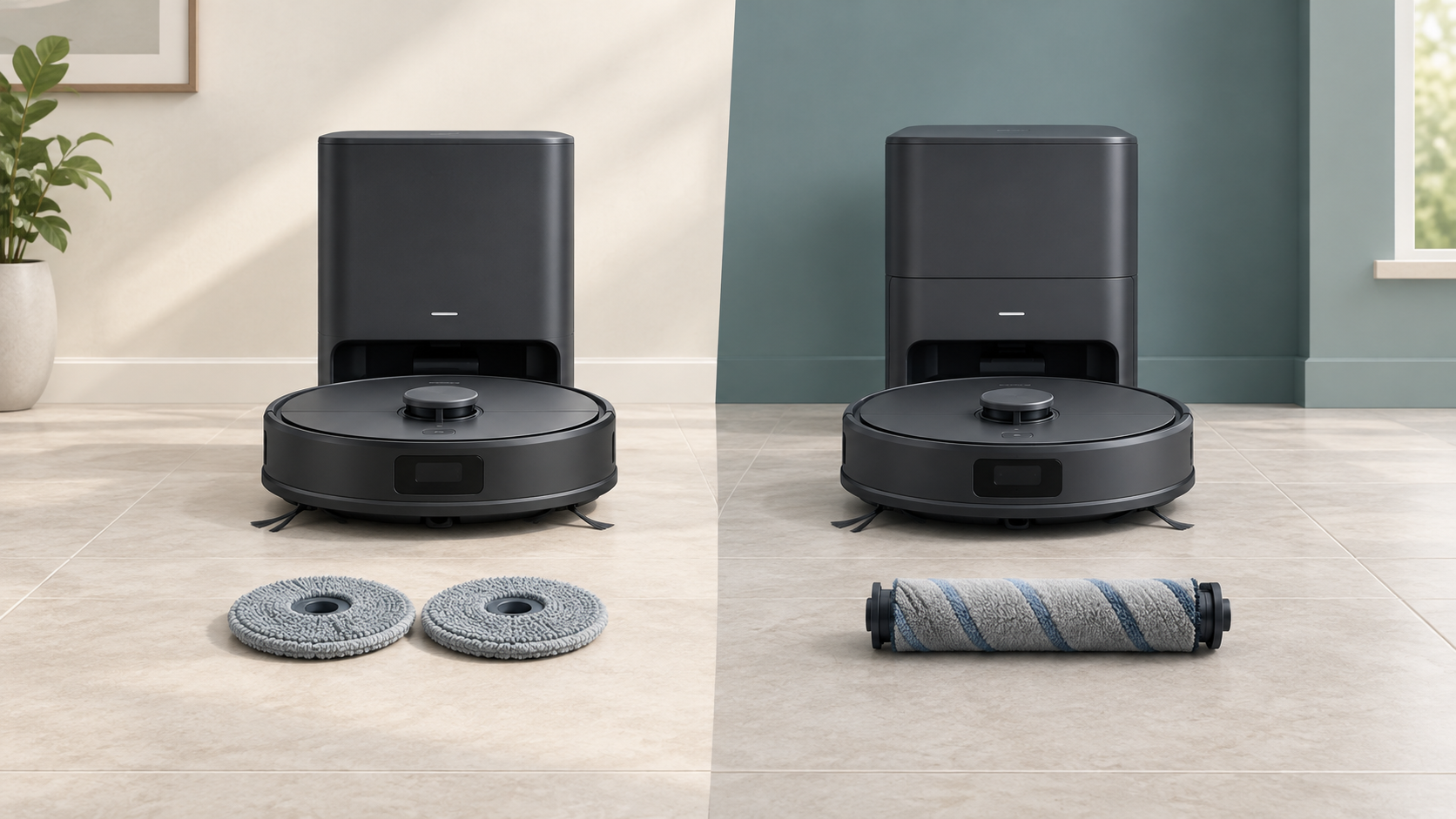
The short answer: the eufy Omni E25 has the more encouraging independent evidence for fine-debris pickup and floor-level pet hair, plus a roller mop that is rinsed during cleaning. The eufy X10 Pro Omni remains worth considering when it is meaningfully cheaper and its documented routine-cleaning performance meets your needs. Neither is an automatic winner for mopping, and the E25’s carpet restrictions deserve particular attention.
Neither robot is automatically right for every home. The E25’s roller mop does not remove every stubborn stain, while the X10’s lower advertised suction figure does not stop it performing well on larger debris, carpet hair and obstacle avoidance.
Bot ’n’ Brush has not tested either robot. This comparison draws on eufy’s UK product information and separate tests published by Expert Reviews, Good Housekeeping, Ideal Home, TechRadar and TechGearLab. Because those publications used different homes, surfaces and test methods, their results should not be treated as a single head-to-head trial.
eufy X10 Pro Omni vs E25 at a glance
| Decision factor | eufy X10 Pro Omni | eufy Omni E25 |
|---|---|---|
| Best fit | Routine mixed-floor cleaning when its purchase price is appreciably lower | Homes prioritising fine debris, floor-level pet hair and a mop that is refreshed during cleaning, subject to eufy’s carpet guidance |
| Mopping system | Two rotating mop pads that return to the station for washing | A roller mop that is rinsed with clean water while it works |
| Dry pickup evidence | Strong results for larger debris and carpet pet hair, but weaker fine-dust results in one independent review | Encouraging recent results for fine debris and pet hair, although positive carpet tests do not override eufy’s restrictions for medium and long pile |
| Hair handling | Good carpet-hair result; no adequate quantified long-hair-wrap comparison | Strong pet-hair observations and little main-brush wrapping in one independent test |
| Mopping evidence | Removed some test marks readily but needed repeated missions for dried ketchup in one review | Positive fresh-spill results but mixed outcomes on more stubborn dried stains |
| Edges | No sufficiently detailed independent result to declare an advantage | Extending side arm, but independent edge-cleaning findings are mixed |
| Obstacle avoidance | Performed well in one controlled object-avoidance test | Handled several test objects but still caught a cable during normal use in one review |
| Reason to choose it | You want the core Omni functions without paying for E25 features you may not need | Its documented pickup differences or continuously rinsed roller address a specific need in your home |
Vacuuming hard floors and carpets
Do not decide between these robots by comparing 8,000Pa with 20,000Pa. Suction pressure is a manufacturer specification, not a complete measure of how much debris a robot will collect. Brush design, airflow, cleaning pattern, surface and selected settings all matter.
The X10 produced credible results in Expert Reviews’ separate testing. It collected most of the rice used on both hard floor and carpet and performed well with pet hair embedded in carpet. Its weaker tasks were flour and loose hair on hard flooring, where some material was left behind or pushed ahead of the robot.
A later Good Housekeeping assessment of the X10 also found it effective on larger kitchen-floor debris and pet hair, while dust pickup was less convincing. That supports a picture of a competent everyday cleaner rather than a uniformly strong performer across every debris type.
In its separate E25 review, Expert Reviews recorded strong rice and dog-hair collection on hard floor and carpet, alongside a better carpet-flour result than it had reported in its older X10 review. Those tests were conducted at different times and should not be presented as a controlled X10-versus-E25 experiment.
TechRadar’s E25 testing found that it collected fine material effectively on hard flooring and performed well on mid-pile carpet. Larger rice grains were sometimes scattered by the side brushes before most were eventually collected, and a few grains remained on higher-pile carpet.
These separate results give the E25 the more encouraging fine-debris evidence, but they do not establish suitability for every carpet. Eufy’s UK carpet restrictions remain important, particularly for medium and long pile. Neither robot should be treated as a complete replacement for manual carpet cleaning.
Pet hair and brush wrapping
“Pet hair performance” covers several different jobs. Loose clumps on a smooth floor behave differently from fur pressed into carpet, and neither task tells us how well a robot will clean sofas, stairs or pet beds.
The X10’s positive evidence is clearest on carpet. Expert Reviews reported strong embedded-hair pickup, while Good Housekeeping also rated its pet-hair cleaning positively. Its weaker hard-floor result shows why a single pet-hair label can be misleading: some loose clumps were pushed ahead rather than immediately drawn into the robot.
The E25 also performed strongly with carpet hair. In TechGearLab’s own pet-hair protocol, it collected most of the test fur and left little hair wrapped around its main rollers. Some hair could still collect around the side brushes or brush connection points, so eufy’s anti-tangle terminology should not be interpreted as a promise of zero maintenance.
There is not enough equivalent long-hair-wrap testing to prove that the E25 tangles less than the X10 under identical conditions. The E25 has encouraging independent evidence, but that is not the same as a quantified advantage over the older model.
If shedding is your overriding concern, the E25 has the broader evidence-led case for floor-level pet hair, subject to the type of flooring involved. Our UK pet-hair robot-vacuum guide is more useful if you have not narrowed the decision to these two eufy systems.
Rotating pads or a roller?
The most important physical change is underneath the robots. The X10 Pro Omni uses two circular pads that rotate against the floor. It periodically returns to its station, where the pads are washed before the robot resumes cleaning.
The Omni E25 replaces those pads with a roller. Separate clean- and dirty-water handling allows the robot to rinse the roller while it is moving around the floor. This is a meaningful functional difference because the roller is refreshed during a cleaning run, but it does not prove that the E25 will remove every type of mark more effectively than the X10.
Fresh spills and light marks
The X10’s pads delivered useful results in Expert Reviews’ tests. At the selected intensive settings, the robot removed dried mud and blackcurrant squash during one cleaning mission.
The E25 also has positive evidence for everyday marks. In an Ideal Home household test, it removed fresh tomato sauce from laminate in one pass. That is a useful result for a recent spill, but it should not be extended to old stains or different flooring.
These observations involved different substances, floor materials and test conditions. They show that both robots can deal with some routine marks, not that either mopping mechanism is universally superior.
Stubborn dried stains
Neither model produced an unqualified win on more difficult stains. Expert Reviews reported that the X10 needed eight cleaning missions to remove dried ketchup, despite clearing its other test marks much more readily.
The E25’s results were mixed too. TechRadar found that its automatically chosen mode did not remove dried ketchup, but manual selection of its maximum mopping settings and several passes did. Expert Reviews found that it removed most of a heavily dried stain from linoleum but manual scrubbing was still needed to finish the job. TechGearLab also reported incomplete removal of dried coffee in its own test.
The fair conclusion is that both systems can handle some everyday marks, while neither has demonstrated a universal stubborn-stain advantage. The E25’s ability to rinse its roller during cleaning is a useful functional difference, but the available tests do not establish that it consistently cleans better than the X10’s rotating pads.
Rugs and floor restrictions
Both robots can raise their mopping components when carpet is detected. Eufy specifies a 12mm lift for the X10’s pads, while the E25 also raises its roller. Neither mechanism should be treated as a guarantee that every rug will remain dry.
The E25 needs particular care here. In its UK carpet-cleaning FAQ, eufy recommends “Vacuum Only” mode for short-pile carpets and “Carpet Avoidance” for medium- and long-pile carpets. It says the latter makes the robot avoid those carpets entirely. The same FAQ warns that dark carpets may not be detected and advises setting a no-go zone.
That guidance limits how broadly we can recommend the E25 for carpet-heavy homes, even though independent reviewers reported positive carpet-cleaning results. A successful review test does not establish suitability for every carpet construction or override the manufacturer’s stated guidance.
If your home has substantial medium- or long-pile carpet, do not choose the E25 on its pickup results alone. Obtain product-specific clarification from eufy before buying it for those areas. For either robot, check the current instructions and your flooring manufacturer’s care requirements before using wet cleaning on a water-sensitive surface.
Navigation, cables and furniture
Both robots combine laser mapping with camera-assisted object recognition. They can create room maps, follow scheduled routines and use app-defined no-go areas, but mapping a home accurately and recognising a small object are separate abilities.
The X10 produced a particularly good result in Expert Reviews’ controlled obstacle test. It avoided a sock, charging cable and imitation pet mess, although it did not classify every item correctly. The same review reported efficient room-to-room navigation, but the robot would not enter beneath a low kitchen-cupboard overhang.
Independent E25 observations were more variable. It avoided and identified a cable, shoe and sock in repeated TechRadar tests, yet later caught and dragged a charging cable during ordinary cleaning. Ideal Home also found it overly cautious around a dumbbell, while another reviewer needed to rescue it from a narrow gap once.
Neither system should therefore be trusted as a reason to leave charging leads, thread, small toys or pet waste on the floor. No object-recognition system makes floor preparation unnecessary, and neither model should be assumed to avoid every hazard.
Low furniture is another potential limitation. Both robots have a raised laser-navigation tower and are roughly similar in overall height. Reviews of each model describe areas they could not enter, so there is not enough consistent evidence to declare a meaningful low-clearance winner. Measure the available opening and compare it with eufy’s current dimensions, allowing for more than the bare physical height.
The docks still need attention
Both stations can empty the robot’s dust bin, replenish water, wash the mopping component and dry it with heated air. The E25 station also automatically dispenses compatible detergent. Separately, the X10 has a Pro-Detangle Comb built into its brush guard, working with reverse roller rotation to help release wrapped hair.
The practical difference is that the E25 can refresh its roller while it is cleaning, whereas the X10 relies on periodic station visits to wash its pads. Both may return to the dock during a longer job, depending on the settings and cleaning demands. This distinction concerns how the mopping components are cleaned; it does not establish which robot will remove a particular stain more effectively.
Neither station is maintenance-free. Owners still need to refill clean water, dispose of dirty water, replace dust bags, check brushes and filters, clear hair or trapped debris and clean the station’s wet area. TechRadar also observed that debris could collect where the E25 dock cleans its roller.
Both docks are sizeable pieces of floor-standing equipment, and inconsistent published dimensions make it unhelpful to declare one the definitive space-saving option. Check the current width, depth and height in the same order, then allow additional access for the robot, water tanks and routine cleaning.
For a broader look at what this automation does and does not remove from your workload, see our guide to whether self-emptying robot vacuums are worth it.
Is the E25 worth paying more for?
The answer depends on the price gap you can actually obtain, not an old launch price or a temporary promotion viewed in isolation. Compare the same colour and base package, then check whether the displayed price requires membership, a coupon or a different seller.
At a small like-for-like price gap, the E25 is easier to consider if fine-debris pickup, floor-level pet hair or a mop that is refreshed during cleaning are priorities. Its roller design is a functional difference, not proof of a mopping win. Check its carpet restrictions before treating it as the better choice for a mixed-floor home.
At a substantially larger gap, the X10 becomes more attractive. It still provides capable larger-debris and carpet-hair pickup, rotating-pad mopping, good app controls, effective object avoidance in one controlled test and a station that handles the main emptying, washing and drying functions.
There is no evidence-based numerical threshold that makes the E25 automatically worth buying. The useful question is whether one of its documented differences solves a problem for which you would knowingly pay more.
Should X10 owners upgrade?
A functioning X10 should not be replaced just because the E25 is newer or has a larger suction number. The X10 already automates vacuuming, mopping, dust emptying, water refilling, pad washing and drying.
An E25 upgrade is most defensible if your X10 repeatedly leaves fine debris or struggles with loose hair on hard flooring. A preference for the E25’s continuously rinsed roller may also matter, but the available stain tests do not prove that it will mop better than the X10 across your floors.
The E25’s low-wrap observations are encouraging, but there is no equivalent long-hair test proving that it will tangle less than your existing X10. Brush wrapping alone is therefore not a sufficiently supported reason to replace an otherwise satisfactory machine.
Nor is the E25 an obvious upgrade for a home dominated by medium- or long-pile carpet. Eufy’s UK guidance advises using Carpet Avoidance for those surfaces, which could prevent the robot from cleaning a substantial part of that home.
Which should you choose?
- Consider the E25 for mostly hard floors if fine dust, loose floor-level hair or having the mop refreshed during cleaning matters more than securing the lowest purchase price. Its roller mechanism does not guarantee better stain removal.
- Consider the E25 for short-pile carpet if its independent hair and fine-debris results address your needs, while following eufy’s carpet-mode guidance. Do not extend that recommendation to medium- or long-pile carpet: eufy’s UK FAQ advises avoiding those surfaces.
- Choose the X10 for routine mixed-floor maintenance when it is meaningfully cheaper and its documented larger-debris, carpet-hair, rotating-pad mopping and obstacle-avoidance capabilities are sufficient.
- Choose neither solely for difficult dried stains, deep carpet cleaning or upholstery. The evidence does not support treating either robot as a complete replacement for manual cleaning equipment.
- Keep a functioning X10 unless the E25 solves a specific, recurring cleaning problem rather than simply offering newer specifications.
Make the final choice around your surfaces, recurring cleaning problems and the actual purchase-price gap. The E25’s encouraging pickup evidence and rinsed roller may justify paying more, but its carpet restrictions and mixed stain results matter. If the X10 already meets your needs—or costs substantially less—newer hardware alone is not a reason to spend more.
1 thought on “eufy X10 Pro Omni vs eufy Omni E25: Which Should UK Buyers Choose?”
Comments are closed.