
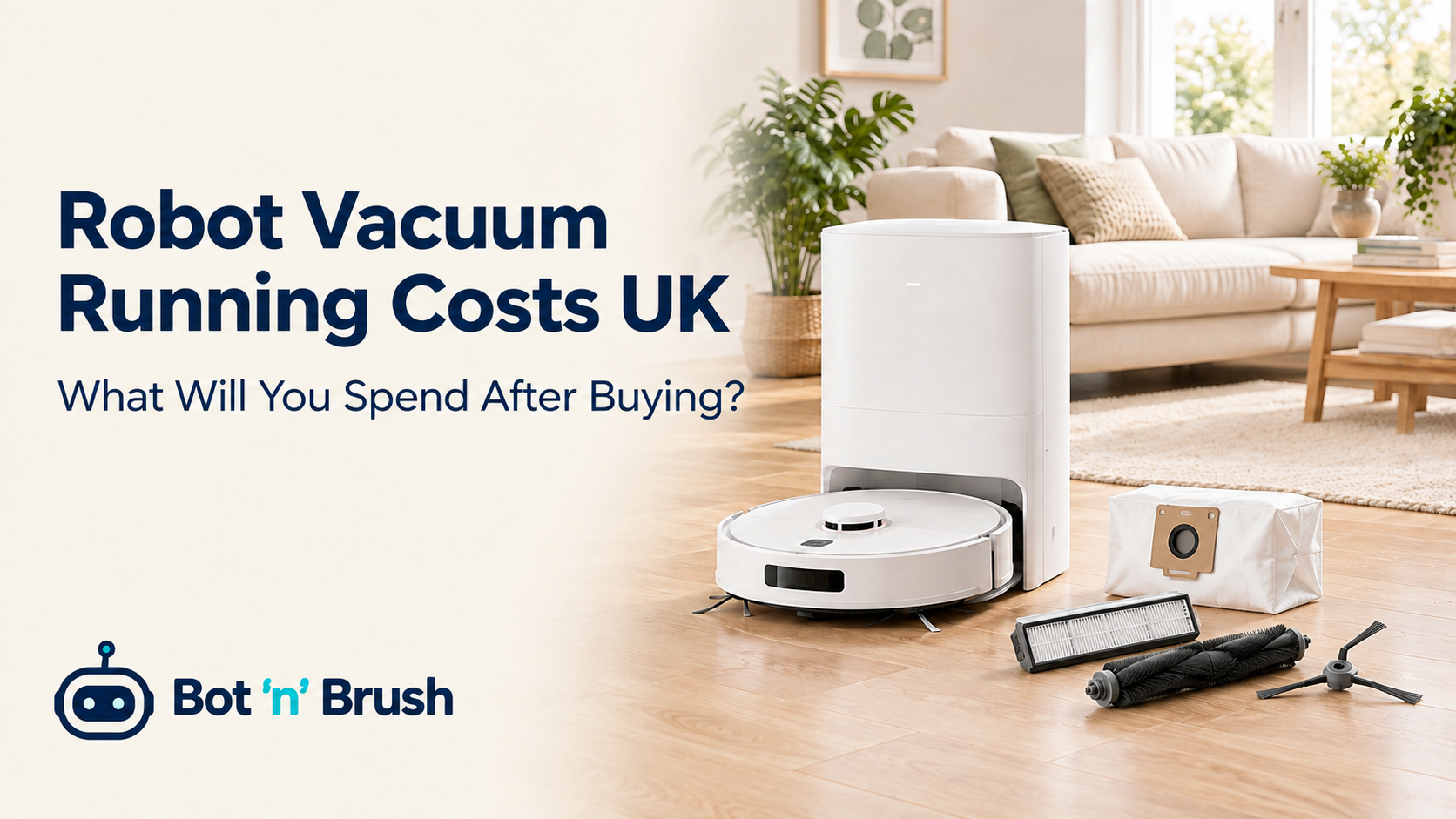
Robot vacuum running costs UK: what will you spend after buying? The answer depends on your model, which consumables it uses, how many you get through and the electricity it draws. As a dated example, eufy’s UK store listed six X10 Pro Omni dust bags for £19.99 on 4 November 2026. Buying that pack is one thing; using all six bags is another, and the difference matters when you budget.
This guide shows a method for working out your own figures, not a universal annual bill. Bot ‘n’ Brush has not tested these parts, measured how long they last or measured this robot’s electricity use, so the numbers below are manufacturer-listed prices and simple sums.
What can cost money after purchase
Not every robot has every cost below, so check what your exact model and dock use.
- Dust bags, if the dock empties the robot into a bag. Our self-emptying robot vacuum guide covers how bagged, bagless and charge-only docks differ.
- Filters, which may be washable or disposable.
- Brushes, including the main roller and side brushes.
- Mop pads or cloths, on models that mop.
- Electricity, including the robot and any powered dock functions.
Repairs and battery replacement also exist, but we have no applicable price evidence for the example below, so we do not estimate them. For cleaning methods, see Robot Vacuum Maintenance: What to Clean, Check and Replace.
A dated example: eufy X10 Pro Omni parts
These are the prices eufy’s UK store displayed on 4 November 2026. They are listed prices, not checkout totals, and they exclude delivery. We did not verify delivery conditions or delivered costs. We chose this model because its manufacturer store lists parts separately, not because it is the best or cheapest option.
| Item | Pack contents | Displayed price | Approximate price per item |
|---|---|---|---|
| Dust bags | 6 bags | £19.99 | About £3.33 each |
| Washable filters | 2 filters | £6.99 | About £3.50 each |
| Mop cloths | 2 cloths (X10 Pro Omni and X9 Pro) | £10.99 | Best read as a pack price |
| Replacement kit | Roller brush with bristles and rubber, brush guard, 2 side brushes, 1 washable filter, 2 mop cloths | £34.99 | Not split per item |
Sources: eufy UK replacement kit page and eufy UK robot vacuum accessories collection, both viewed 4 November 2026.
- The kit’s availability was unresolved. Its product page displayed £34.99, but the collection labelled it Sold Out. Treat the price as a listed reference, not a verified purchasable offer.
- The mop cloths are a pack price. We have no evidence that one cloth alone is a full replacement, so the £10.99 is not split.
Paying for packs versus using bags
Three terms describe the same purchase:
- Cash paid for packs is the money you hand over for whole packs.
- Cost of bags used is the share of the pack’s purchase price attributable to those bags. It is not an additional payment or a resale valuation.
- Spares left over are bags you have paid for but not yet used.
For the six-pack at £19.99, the cost of bags used is £19.99 × bags used ÷ 6. The table assumes you start with no spare bags and buy only these six-packs, with no discounts, price changes or delivery charges. The quantities are hypothetical examples for a chosen period, which need not be a year. They are not measured, typical or recommended usage.
| Bags used | Cash paid for packs | Cost of bags used | Bags left |
|---|---|---|---|
| 4 | £19.99 (one pack) | About £13.33 | 2 |
| 6 | £19.99 (one pack) | £19.99 | 0 |
| 12 | £39.98 (two packs) | £39.98 | 0 |
In the four-bag row you still pay £19.99. The two spares account for about £6.66 of that price (£19.99 × 2 ÷ 6), and the four bags used account for about £13.33. The two unused bags remain as spare stock for a later period.
Budget for your own robot
Work through these steps for your model.
- Choose your budgeting period, such as a season or a year.
- Identify the compatible consumables your robot and dock use, and each pack’s quantity. Robot Vacuum Replacement Parts UK explains how to check fit.
- Note what you already have: items that came with the robot and any spare stock. Using these does not require a new purchase in that period.
- Make your own assumption about how many of each item you will use. Manufacturer advice is a starting point, not a forecast.
- Work out the whole packs you would need to buy, after allowing for existing supplies, and add any delivery charge on each order.
- If you buy a replacement kit, do not count its contents again as separate purchases.
- Add electricity only if you have measured kWh, using your own tariff rate.
For example, suppose you hold two spare bags and expect to use ten during your period. You need eight more, so you buy two six-packs for £39.98 in cash and finish with four bags left (2 + 12 − 10). The ten and the 12 here are hypothetical, not a recommendation.
Your cash budget records what you pay for packs during the period. A usage-cost comparison records the purchase cost attributable to the items used, including any bought earlier. If you do not know what existing spares cost, leave that part unpriced rather than assuming they cost nothing. These figures answer different questions; do not add them together.
Why replacement advice is not a spending forecast
eufy’s kit page says to replace the kit every 3–6 months, depending on how often you use the robot. That is a manufacturer recommendation, not a measured lifespan, and it does not show that the roller brush, side brushes, filter and mop cloths wear out together.
Following that recommendation would produce a particular spending scenario, but it would not establish what every owner needs to spend. We therefore show the listed kit price without turning it into a predicted annual bill. Follow the applicable manufacturer instructions when deciding what to replace.
Electricity: the formula
Maximum rated power is not actual consumption, and we have no measured figure for this robot and dock. If you measure it, for example with a plug-in energy monitor, the sum is:
Cost in £ = measured kWh × unit rate in p/kWh ÷ 100
Use the unit rate on your own bill, and leave out your standing charge, which you pay whether or not you own a robot.
As an arithmetic illustration only, 10 kWh at 26.32p/kWh costs about £2.63. The 10 kWh is arbitrary, not a measurement of any robot. Ofgem lists 26.32p/kWh as the average Direct Debit electricity unit rate for England, Scotland and Wales for 1 October to 31 December 2026. It is not a universal UK tariff, and rates vary by region and payment method. See Ofgem’s price cap unit rates and standing charges page.
Using this guide
Identify the right parts for your model, estimate how many you will use, then allow for supplies you already hold before pricing the whole packs you need. Check delivery at checkout and add electricity if you have measured consumption. Keep your usage assumptions alongside the figures so you can update the budget as you learn what your robot uses.