
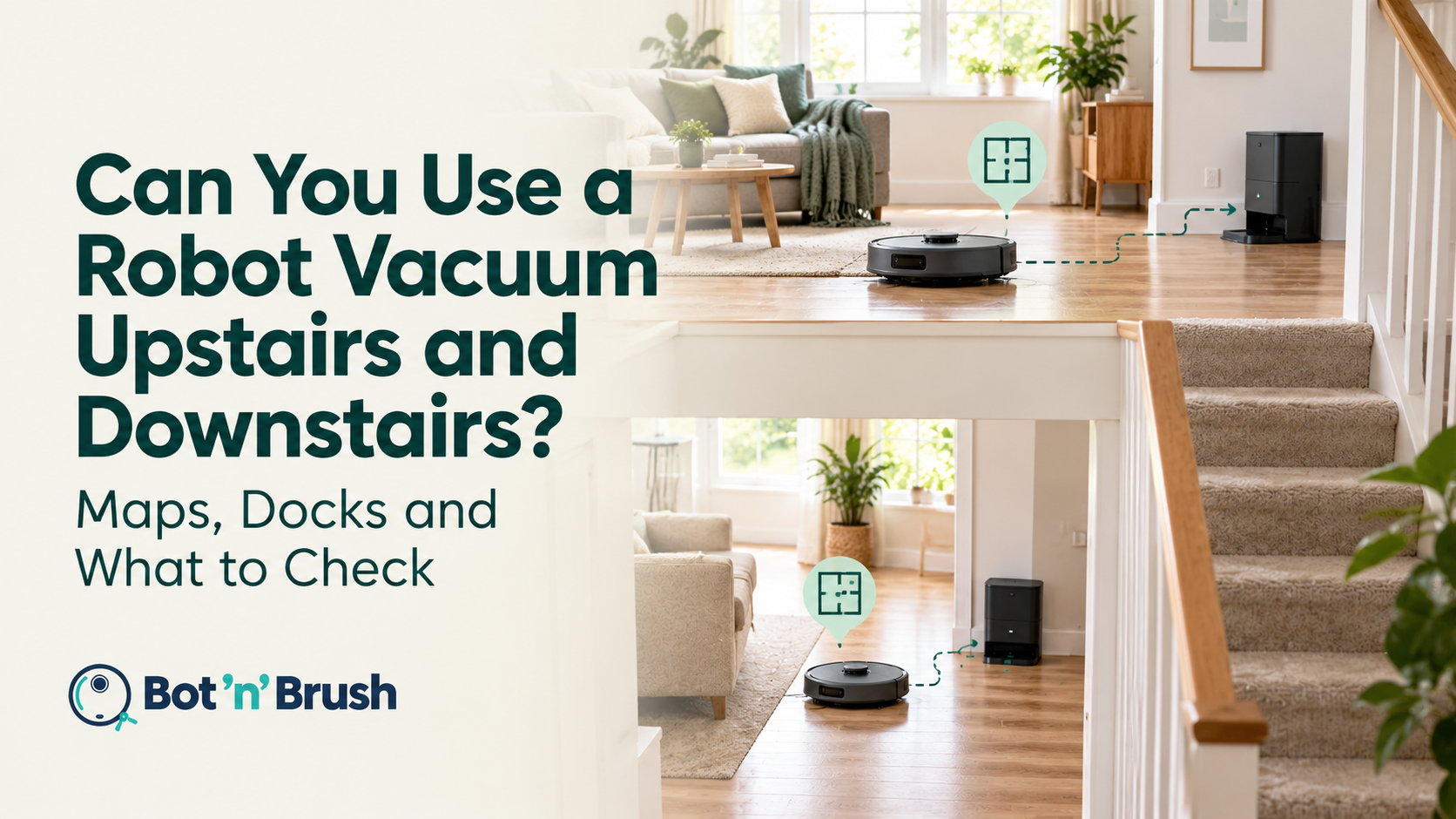
Yes, you can use one suitable robot vacuum upstairs and downstairs, but someone still needs to move it between the separate floors in the examples below. Saving several maps does not provide transport or access to a station on another level.
Sharing may be manageable if carrying and occasional intervention are acceptable. It offers less unattended convenience when the other floor regularly needs charging, bin emptying or station-based mop servicing.
This guide draws on manufacturer instructions, not hands-on multi-floor testing by Bot ’n’ Brush. The original Roborock S7 and eufy X10 Pro Omni illustrate different arrangements; they are not purchase recommendations.
Several maps are only part of the routine
Before sharing a robot between floors, separate four questions:
- Can it save a map for each floor?
- Can it recognise the intended floor and work out where it is?
- How will it get there?
- Which charging, emptying and mopping services will it need during the job?
“Multi-floor mapping” answers only part of that list. What matters is whether the complete routine fits your home, from preparation to servicing afterwards.
A doorway threshold, a single step and a flight of stairs are different access problems. A threshold-crossing claim is not evidence that a robot can travel between storeys. Our guide to robot-vacuum navigation explains the mapping technology; here, the focus is what you will need to do.
Prepare for the job before moving the robot
Decide what the robot will clean and whether it can finish before needing attention.
- Maps: confirm that multiple maps are supported and the relevant saving option is enabled.
- Cleaning mode: check that the intended vacuuming or mopping task works away from the station.
- Battery: allow enough charge for the planned job rather than relying on an advertised maximum runtime.
- Bin space: start with enough onboard capacity for the debris you expect.
- Water and mops: complete the preparation required for that cleaning system.
A manually filled tank and cloth need different preparation from pads serviced by a washing station. If mopping regularly needs fresh water or pad washing during a run, sharing the robot may involve extra preparation and return trips.
Our guide to robot-vacuum mopping explains the different systems in more detail.
Carry the robot and check which map it is using
Both examples here need someone to carry the robot between disconnected levels. Consider whether its weight and shape are manageable on your stairs, and follow its safety and handling instructions.
Move it at an appropriate point in its routine. For example, eufy’s X10 mapping guidance warns against moving it during mapping or cleaning. Its separate mopping guidance describes carrying it after pad cleaning has finished.
A saved map still needs to be recognised
Roborock’s multi-floor guidance, using the original S7 as its example, says subsequent floors can be mapped without moving the dock. Once the maps exist, the owner can move the robot alone to a saved floor and start it; the robot recognises the floor and uses the corresponding map.
The X10’s documentation confirms multiple-map storage but does not clearly explain whether routine floor selection is automatic or manual. Before depending on it, find out how to confirm the intended map and what to do if the wrong one appears.
Check the floor’s room settings and exclusions too. The S7 supports relocation, but its manual warns that manual movement can affect maps or exclusions. Do not assume every room name, restriction and schedule will remain separately stored after every move.
Protect stairs and open drops
Do not assume cliff sensors prevent every fall. Follow the current safety instructions, use suitable physical protection where required, and do not rely solely on virtual cleaning zones at an open drop.
The S7 manual requires a secure physical barrier in raised areas. The X10 manual gives inconsistent advice about virtual-zone protection and says those zones are not designed to isolate hazardous areas. They should not be your only protection against a fall.
Do not test an unprotected stair edge or override the robot’s sensors.
What changes when the dock stays downstairs?
The dock’s functions determine what the robot loses access to when you move it elsewhere:
- A basic charging dock supplies charging.
- A self-emptying station also transfers debris out of the onboard bin.
- A multifunction station may add mop washing, water replenishment and drying, depending on the package.
Without access to its emptying station, the robot must collect the run’s debris in its onboard bin unless you intervene. A basic spare charger would not replace a multifunction station’s washing or refilling services.
For more on the dry-debris side, see our guide to whether self-emptying robot vacuums are worth it.
Where will it finish?
The X10 Pro Omni multi-floor FAQ says vacuuming operates as usual without the Omni Station and the robot returns to its starting point after the cycle.
The S7 guidance describes returning to the starting point after mapping another floor. Its manual also says that if it cannot find its dock, it returns to its most recent starting location.
Those are the intended documented outcomes, not guarantees under every fault or low-battery condition. You will still need to collect the robot afterwards.
Mopping needs a closer look
The two examples show why “can mop” is not enough to settle whether sharing one robot will be convenient.
Original Roborock S7: a manually prepared tank and cloth
The original S7 with its standard charger uses a manually filled tank and a cloth that the owner wets and squeezes before fitting. The charger does not wash the cloth or refill the tank.
The manufacturer’s S7 manual, available here through a third-party-hosted copy, describes pausing to add water or clean the cloth, then reinstalling the module and continuing.
These are its ordinary mopping instructions, not a separate upstairs procedure. They show the manual work involved but do not provide a guaranteed area per tank.
eufy X10 Pro Omni: confirm the applicable guidance first
eufy’s dedicated guide to mopping away from the station describes using the X10 on another floor with firmware 2.1.0 or newer, after preparation at the Omni Station.
However, its general multi-floor FAQ gives conflicting advice, saying mopping requires the station on the same floor. Confirm which instructions apply to your UK firmware before relying on this arrangement.
The preparation wording also leaves the onboard filling sequence unclear. Follow the applicable manufacturer instructions rather than improvising a manual filling method.
What happens if it needs attention halfway through?
Automatic recharge-and-resume normally depends on the robot reaching its station. It does not establish that you can carry it downstairs, charge it and carry it back with the unfinished job remembered.
Manual charging may mean starting again
The S7 manual explicitly says that placing a paused robot on its charging dock ends the current cleanup. It also says manually docking before an automatic top-up return prevents continuation.
For the X10, the public guidance does not clearly say whether carrying, charging, refilling or redocking keeps the unfinished job. This matters most when the planned run is unlikely to finish without help.
Low water can leave an area unmopped
The X10’s dedicated mopping guide describes a low-water situation in which the pads lift and the remaining areas are swept rather than mopped. A completed run may therefore leave part of the intended mopping unfinished.
Its reference to pads drying in approximately ten minutes is not a total mopping-runtime limit. The guide does not explain that response separately for each named mopping mode.
Ask before relying on an upstairs run
Use these questions to close the gaps that matter to your planned routine:
- Can this model perform my intended task without its station?
- How do I confirm the correct floor and its cleaning restrictions?
- What happens if it needs charging or a mop wash before finishing?
- Will manual charging or refilling keep the unfinished job?
For the X10 in particular, the guidance does not clearly answer what happens when a scheduled pad wash becomes due on a floor without the station. Resolve that before depending on a run that needs mid-clean washing.
Allow for servicing afterwards
Once you have brought the robot back, deal with the bin, unused water, cloth or pads as instructed and put it in the appropriate place for charging or station services.
Do not assume every emptying, washing or drying function starts automatically after manual redocking. Our robot-vacuum maintenance guide covers general care; the extra question here is where that work happens and whether it fits your routine.
Which arrangement fits your household?
The dividing line is how much unattended cleaning you need, compared with how much carrying and intervention you are happy to do.
| Your situation | Arrangement worth considering | Main check |
|---|---|---|
| Occasional vacuuming on the second floor | One shared robot may be manageable. | Can it finish on its available charge and bin space, with carrying and retrieval acceptable? |
| Frequent unattended cleaning on both floors | Separate machines may fit better. | Do you have suitable space and accept the purchase and upkeep commitments? |
| Mopping that regularly needs station services | A machine and compatible station on each floor may reduce intervention. | Which washing, refilling and charging services does each arrangement actually provide? |
| Carrying is unsuitable for the household | A shared arrangement that depends on carrying is unlikely to fit; consider separate machines or another cleaning routine. | Can each floor be cleaned without moving the robot between levels? |
A schedule still needs the shared robot to be on the intended floor before the job begins. If nobody will be there to move it, that limits which floor can receive unattended cleaning.
Separate machines involve another purchase, space and upkeep commitment. Actual total costs depend on the packages being compared; two machines are not universally better or cheaper.
An additional compatible station is another possibility where the manufacturer supports it. eufy mentions this for the X10, but UK compatibility, supply and setup have not been verified here. It would not remove the need to carry the robot between disconnected floors.
Your upstairs-and-downstairs checklist
- Safe access: manageable carrying and appropriately protected drops.
- Maps: supported floor storage and a clear way to select or recognise the right floor.
- Cleaning mode: documented working away from the station.
- Capacity: enough battery, bin space and water for the intended job.
- Interruptions: understood charging, washing and unfinished-job recovery.
- Servicing space: somewhere suitable to charge, empty and care for the mops.
- Household fit: preparation and retrieval you will realistically keep doing.
Sharing looks more practical when carrying is manageable and the second floor can usually be cleaned without help. If both floors need frequent unattended cleaning or repeated station services, compare arrangements that keep those services available where they are needed. Choose around the whole routine, not the number of maps advertised.